
As long-term airway management places continuous demands on both tube performance and patient comfort, the design of a Disposable Tracheostomy Tube has become an important consideration for hospitals, medical distributors, and airway-management professionals. A tracheostomy tube needs to provide a stable airway while limiting unnecessary mechanical stress on the tracheal wall. For this reason, details such as cuff pressure, tube-wall thickness, surface smoothness, material flexibility, distal-tip geometry, and resistance to kinking can all influence overall device performance.
For medical device buyers, evaluating a tracheostomy tube therefore involves more than checking the available size. The relationship between the cuff and tracheal wall, the behavior of the tube during patient repositioning, and the consistency of manufacturing are also important technical factors. SuJia Medical's Disposable Tracheostomy Tube range is designed around these considerations, with cuffed and uncuffed configurations from 2.5 to 10.0 and features intended to support reliable airway management.
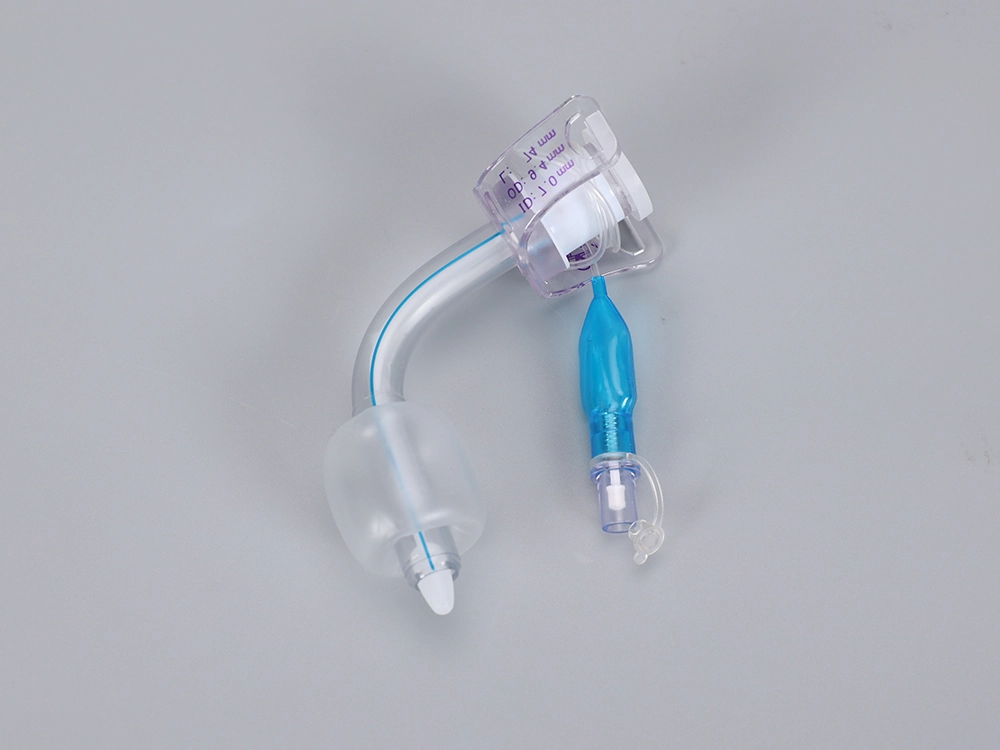
For a cuffed tracheostomy tube, the cuff forms a seal between the tube and the tracheal wall. The challenge is to achieve an effective seal without creating unnecessary localized pressure on the mucosa. A low-pressure, thin-walled cuff can help distribute the contact force over a broader area rather than concentrating excessive pressure at a small section of the tracheal wall. This design principle is particularly relevant when the tube remains in place for an extended period.
Cuff design also needs to balance sealing performance with inflation characteristics. If the cuff does not seal adequately, ventilation efficiency can be affected and air leakage may occur. Conversely, excessive cuff inflation can increase pressure against the surrounding tissue. Therefore, a practical Disposable Tracheostomy Tube should be designed to achieve the required airway seal at an appropriate cuff pressure rather than simply relying on a thicker or more rigid cuff structure.
The thin-wall construction described by SuJia Medical is intended to support this balance. Its product design specifically uses a low-pressure, thin-walled cuff to protect the tracheal mucosa while maintaining the functional requirements of a cuffed airway device.
The tube body is another key factor in airway protection. A tracheostomy tube needs sufficient structural stability to maintain its lumen while also being flexible enough to accommodate patient movement. A tube that is excessively rigid may transmit more mechanical force to the surrounding tissue, while insufficient structural strength may increase the possibility of deformation or kinking.
Medical-grade PVC is commonly used in disposable airway devices because its material properties can be engineered to provide a combination of flexibility, smoothness, and dimensional stability. For a Disposable Tracheostomy Tube, a smooth tube surface can help reduce friction during insertion and minimize unnecessary contact with the tracheal tissue. Material consistency is equally important because variations in wall thickness or mechanical properties can affect how the tube behaves after placement.
SuJia Medical's product description emphasizes a soft and smooth tube, together with a tapered stylet and smooth tip. These features are designed to facilitate insertion while reducing tissue trauma. The tube is also designed to resist kinking when the patient's position changes, helping maintain a stable airway geometry during routine care and repositioning.
Insertion is another stage at which mechanical design can influence tissue interaction. A poorly controlled or excessively rigid insertion system may increase resistance as the tube passes through the tracheostomy opening. A tapered stylet can provide a smoother transition at the leading end, while a rounded or smooth distal tip can reduce the possibility of the tube catching against tissue.
This is particularly relevant when the product is being selected for different patient populations. A Disposable Tracheostomy Tube manufacturer must maintain dimensional consistency across different sizes so that the relationship between the tube, stylet, cuff, and connector remains predictable. SuJia Medical lists cuffed and uncuffed models from 2.5 to 10.0, providing a relatively broad size range for different clinical requirements.
Clear scale markings also have a practical role. They provide visual reference information during placement and help medical personnel assess tube position more consistently. The international standard connector, meanwhile, is intended to support compatibility with corresponding respiratory equipment and accessories.
For a medical device manufacturer, airway safety begins with controlled manufacturing rather than only final-product inspection. Material selection, molding or forming parameters, component assembly, dimensional tolerances, and functional inspection all influence the final characteristics of a Disposable Tracheostomy Tube.
SuJia Medical states that it has been engaged in medical device manufacturing since 1992 and has established a dedicated R&D structure, manufacturing enterprises, and cleanroom production capabilities. Its company information also describes quality-control processes, international certifications, and a broad portfolio of disposable medical devices covering anesthesia, nursing, infusion, monitoring, pain management, and other applications.
From a procurement perspective, manufacturing consistency is especially important for components such as cuffs and connectors. Dimensional inspection can help verify tube diameter, length, wall characteristics, and component positioning, while mechanical and functional checks can help identify issues related to deformation, connection, or assembly. Consistent process control also helps manufacturers maintain more predictable product performance between production batches.
SuJia Medical's broader manufacturing profile reports a Class 100,000 cleanroom, professional technical personnel, R&D investment, and quality-control infrastructure. These capabilities provide a manufacturing foundation for producing disposable airway-management products at scale.
When sourcing a Disposable Tracheostomy Tube, buyers should look beyond product photographs and basic dimensions. The first consideration is the product specification, including cuffed or uncuffed configuration, available tube sizes, connector design, markings, and accessories such as stylets. Different clinical applications may require different combinations of these features.
The second consideration is quality management. Buyers can review the manufacturer's quality system, production environment, inspection procedures, regulatory documentation, and applicable market certifications. For distributors and international buyers, documentation supporting product registration and market access can also be important when evaluating long-term supply relationships. SuJia Medical states that selected products have obtained EU CE and US FDA certifications and that the company has established overseas sales coverage.
The third consideration is R&D and manufacturing capability. A manufacturer with its own technical and production infrastructure may be better positioned to address requirements involving size ranges, material selection, product customization, packaging, and future product development. SuJia Medical reports more than 80 patents, a dedicated R&D team, and a joint laboratory with Zhejiang University, reflecting an emphasis on medical-device development alongside production.
For hospitals, distributors, and medical-device sourcing companies, the most useful approach is therefore to evaluate the entire product system: cuff performance, material properties, insertion design, anti-kinking behavior, dimensional consistency, quality management, and manufacturing capability. A well-engineered Disposable Tracheostomy Tube should not only establish an airway but also address the mechanical factors that influence tissue contact and device stability throughout use.